
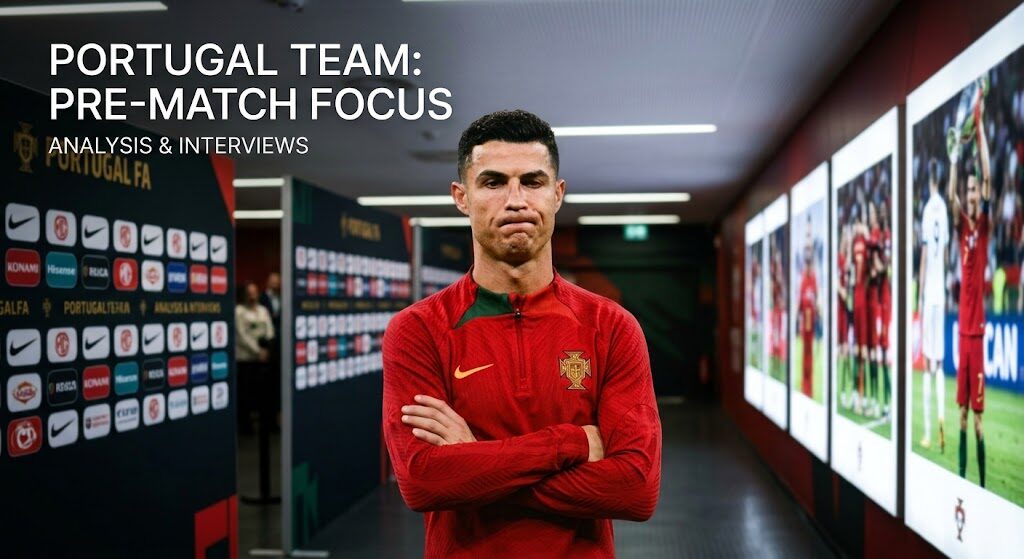
Football superstar Cristiano Ronaldo has been suspended for 30 days by the Portuguese Football Association following a controversial incident in which he left Portugal’s national team camp amid a disagreement with head coach Jorge Jesus.
The disciplinary decision, announced on Monday, October 19, 2026, also includes a fine of €255, equivalent to approximately $285. The ruling represents a significant development in the career of one of the most celebrated footballers in history, raising fresh questions about discipline, leadership and the future of Portugal’s national team captain.
According to reporting by Reuters, published by Al Jazeera, the federation’s disciplinary council upheld the charge against the 41-year-old forward in full. The case followed Ronaldo’s departure from Portugal’s training camp in Copenhagen before the country’s Nations League match against Denmark earlier in October.
The incident reportedly stemmed from a disagreement over Ronaldo’s role in the team. The forward believed that coach Jorge Jesus had failed to honour previous assurances about his playing time after he was left on the bench during Portugal’s match against Norway.
Although Ronaldo remains one of Portugal’s most influential football figures, the decision demonstrates that even an established international captain can face disciplinary consequences when national team obligations are involved.
However, several important questions remain unanswered. The federation’s announcement did not specify which matches or activities the suspension covers, nor did it clarify whether time already served under a provisional suspension will count towards the 30-day punishment.
What Happened Between Cristiano Ronaldo and Jorge Jesus?
The dispute began during Portugal’s October international break, when Ronaldo expected to play a role in the national team’s Nations League fixtures.
Following the match against Norway, in which Ronaldo was reportedly an unused substitute, tensions emerged over the forward’s position in the squad and the assurances he believed had been made about his involvement.
Ronaldo subsequently accused Jesus of breaking his word on two occasions concerning his role in the team. The disagreement escalated when the striker left Portugal’s training camp in Copenhagen before the scheduled match against Denmark.
The incident attracted widespread attention because Ronaldo is not an ordinary squad member. He is Portugal’s captain, its all-time leading international goalscorer and one of the most recognisable sporting personalities in the world.
A player of his experience and stature leaving an international camp inevitably raises questions about team discipline, communication between players and coaches, and the responsibilities that accompany leadership.
Jesus, however, denied having made an agreement with Ronaldo about his playing time. Following Portugal’s 2-1 victory, the coach indicated that the door remained open for the forward’s return.
The disagreement therefore involves two different perspectives: Ronaldo’s belief that assurances were not honoured and the coach’s denial that such an agreement existed.
Without further evidence establishing exactly what was discussed between them, it would be premature to conclude that either side has been proven right on the underlying disagreement.
What is clear is that the dispute resulted in formal disciplinary proceedings against the Portuguese captain.
Why Did Portugal Suspend Cristiano Ronaldo?
Portugal’s Football Association opened disciplinary proceedings on October 9, 2026, following the events reported two days earlier.
The federation’s disciplinary council subsequently found that Ronaldo had intentionally committed an offence under Article 160(1) of its disciplinary regulations.
The council upheld the charge and imposed a 30-day suspension alongside the €255 fine.
The distinction between the original disagreement and the disciplinary offence is important. Ronaldo’s concerns about his role in the team were part of the background to the incident, but the disciplinary case concerned his conduct in leaving the national team camp.
International footballers are expected to follow the rules and obligations established by their national associations when called up for duty. A dispute over selection does not automatically remove those responsibilities.
The punishment also highlights the additional responsibility associated with being captain. Ronaldo has repeatedly served as the face of Portuguese football, and his actions can influence how supporters and teammates perceive the national team.
Interestingly, Ronaldo had already acknowledged that his decision to leave camp was not the best way to handle the situation. He apologised for leaving his teammates and for failing to acknowledge supporters after the Norway match.
He also said that he remained available for selection after serving any punishment resulting from the incident.
His willingness to accept disciplinary consequences may prove important as Portugal considers how to move forward.
Will Cristiano Ronaldo Miss Portugal’s Next Matches?
One of the biggest questions following the suspension concerns Ronaldo’s availability for Portugal’s upcoming international fixtures.
The federation’s disciplinary announcement did not specify which matches or activities would be affected by the 30-day sanction. It also did not explain whether the period already served under the provisional suspension would be deducted from the final punishment.
These details matter because a 30-day suspension does not necessarily translate into missing a particular number of international matches. The consequences depend on the scope of the sanction, the dates involved and the applicable competition rules.
Portugal has been scheduled to face Denmark and Wales in November, making Ronaldo’s eligibility an important issue for the national team.
The suspension should therefore not be interpreted as confirmation that Ronaldo will miss either match. Equally, his statement that he remains available for selection does not override the disciplinary ruling.
Until the federation clarifies the position, his availability must be treated as unresolved.
For supporters, the uncertainty is particularly significant because Ronaldo’s international career has been defined by his longevity, goalscoring achievements and continued desire to represent his country.
Portugal’s President Wants Ronaldo Back
Despite the controversy, Portuguese Football Association president Pedro Proença has indicated that the federation wants Ronaldo to return to the national team once the matter has been resolved.
That message is significant because it suggests the disciplinary decision does not automatically mark the end of Ronaldo’s international career.
Portugal continues to have reasons to value the experienced forward. His goalscoring record, knowledge of major tournaments and influence within the squad have made him an important figure in the country’s football history.
Nevertheless, a successful return will require more than a public statement of support.
The federation, coaching staff and player will need to establish a clear understanding of expectations, selection decisions and disciplinary responsibilities. Better communication could help prevent another disagreement over playing time from developing into a wider team issue.
For Ronaldo, accepting the outcome of the disciplinary process and demonstrating a willingness to work within the coach’s plans could help rebuild confidence.
For Jesus, managing a player with Ronaldo’s reputation presents its own challenge. The coach must make decisions based on the team’s needs while communicating those decisions in a way that maintains trust and professionalism.
Both men have an interest in resolving the dispute constructively, particularly if Portugal hopes to continue building on its recent international achievements.
Cristiano Ronaldo’s Journey From Madeira to Global Football Stardom
To understand why this controversy has generated so much attention, it is necessary to look at Ronaldo’s remarkable career.
Cristiano Ronaldo dos Santos Aveiro was born on February 5, 1985, in Funchal, Madeira, Portugal. His rise from a young football enthusiast on a Portuguese island to a global sporting icon is one of football’s most recognisable success stories.
Ronaldo developed his early football skills in Madeira before joining Sporting CP’s academy in Lisbon. His pace, technical ability, confidence and determination quickly distinguished him from other young players.
His performances at Sporting attracted the attention of Manchester United, where he moved in 2003.
Under Sir Alex Ferguson, Ronaldo developed from an exciting young winger into one of the world’s most dangerous attacking players. He improved his finishing, physical strength, movement and ability to influence important matches.
His first spell at Manchester United brought major domestic and European honours, including the UEFA Champions League title in 2008. That same year, he won his first Ballon d’Or, establishing himself among football’s elite.
In 2009, Ronaldo joined Real Madrid in a transfer that became one of the defining moments of modern football.
Real Madrid: The Peak of Ronaldo’s Goalscoring Career
Ronaldo’s time at Real Madrid transformed his reputation even further.
He became the Spanish club’s all-time leading goalscorer, scoring 450 goals in 438 appearances across competitions, according to FIFA’s career profile.
His performances helped Real Madrid win numerous trophies, including four Champions League titles during his time at the club. He also won multiple individual awards and developed one of the most prolific goalscoring records the sport has seen.
Ronaldo’s rivalry with Lionel Messi during this period became a central story in world football. Their competition drove extraordinary individual performances and dominated discussions about the greatest players of their generation.
Yet Ronaldo’s achievements extended beyond his rivalry with Messi. His ability to score with both feet, finish headers, take penalties and deliver in high-pressure matches made him a remarkably versatile forward.
He also developed a reputation for exceptional physical preparation, maintaining a high level of performance through changes in coaches, teammates and tactical systems.
Juventus and Manchester United Return
In 2018, Ronaldo moved from Real Madrid to Juventus in Italy.
He continued scoring regularly and helped the club win domestic titles during his three-year spell in Turin. His move demonstrated that he could adapt to a different league and continue contributing at the highest level.
Ronaldo returned to Manchester United in 2021, producing memorable performances and scoring important goals during his second spell.
However, his return also became complicated by disagreements over his role, selection and the direction of the club. He departed Manchester United in November 2022.
That chapter is relevant to the current controversy because it illustrates how difficult the transition from being a team’s central figure to accepting a different role can become, even for an established superstar.
It does not prove that the circumstances in Portugal are identical, but it underlines the importance of communication between elite players and their managers.
Al-Nassr and a New Chapter in Saudi Arabia
In January 2023, Ronaldo joined Al-Nassr in Saudi Arabia, beginning a new phase of his playing career.
His arrival attracted global attention and helped increase international interest in the Saudi Pro League. His presence also contributed to the league’s efforts to attract prominent international players.
Ronaldo has continued to pursue personal goals and team honours in Saudi Arabia while maintaining his involvement with Portugal.
According to Al Jazeera’s October 10 reporting, he returned to club action following the Portugal controversy and scored in Al-Nassr’s 3-0 victory over Diriyah.
That performance showed that the dispute with the national team had not prevented him from returning to competitive club football.
However, his club form and his eligibility for Portugal are separate matters. The suspension concerns his relationship with the national association and must be resolved under the applicable disciplinary rules.
Cristiano Ronaldo’s Records With Portugal
Ronaldo’s achievements for Portugal are a major reason the suspension has become such a significant story.
UEFA’s records, updated in September 2026, list him with 234 international appearances and 146 goals for Portugal, both men’s international records at the time of publication.
His international career has spanned more than two decades, allowing him to represent Portugal across multiple generations of players.
He has participated in six FIFA World Cup final tournaments, from 2006 through 2026, becoming the first player to score at six different men’s World Cups.
Ronaldo has also appeared in six European Championship final tournaments, establishing remarkable longevity at the highest level of international competition.
One of the most important achievements of his international career came at Euro 2016, when Portugal won its first major senior men’s international tournament.
Although Ronaldo was forced to leave the final against France through injury, he remained an influential presence from the sidelines as Portugal secured a historic victory.
Portugal subsequently won the inaugural UEFA Nations League in 2019, giving Ronaldo another major international title.
These achievements explain why the federation’s president has expressed a desire for Ronaldo to return after the disciplinary matter is settled.
His legacy is not limited to statistics. He has been central to Portugal’s football identity for years, helping inspire younger players and raising expectations for the national team.
Could the Suspension Damage Ronaldo’s Legacy?
The disciplinary action creates an uncomfortable moment for a player whose career has been built on winning, ambition and a strong public identity.
However, one disciplinary incident does not erase decades of achievements.
Ronaldo’s record-breaking goalscoring, Champions League triumphs, international honours and longevity remain part of football history regardless of the outcome of this dispute.
The more important question is how he responds.
Great athletes are often judged not only by their victories but also by how they handle difficult periods. Acknowledging mistakes, accepting consequences and rebuilding relationships can demonstrate leadership just as clearly as scoring decisive goals.
Ronaldo has already apologised for leaving his teammates and failing to acknowledge supporters after the Norway match. His next steps will help determine whether the incident becomes a brief controversy or a more damaging chapter in his international career.
Portugal’s response will matter too. The federation must apply its rules consistently while ensuring that disciplinary action does not become a substitute for clear communication between coaches and players.
Ultimately, the objective should be to protect the national team’s standards while allowing the best available players to contribute when eligible.
What Happens Next for Cristiano Ronaldo and Portugal?
The immediate priority is clarification of the 30-day suspension.
Supporters need to know precisely which activities are covered, when the sanction expires and whether the provisional suspension period will count towards the final punishment.
The next priority is resolving the relationship between Ronaldo and Jesus.
A productive outcome would involve clear expectations about Ronaldo’s role, honest communication regarding selection and an understanding that the coach retains responsibility for choosing the team.
Ronaldo, meanwhile, will need to demonstrate that he can accept selection decisions even when they differ from his expectations. His experience and leadership could remain valuable to Portugal, but those qualities must operate alongside the team’s disciplinary framework.
The federation’s stated desire to welcome him back offers a possible route towards reconciliation.
Whether that happens smoothly will depend on the actions and decisions taken by everyone involved.
Conclusion: A Difficult Moment in a Legendary Career
Cristiano Ronaldo’s 30-day suspension is a reminder that even football’s greatest stars are subject to the rules governing their teams and national associations.
The €255 fine and suspension follow his departure from Portugal’s training camp amid a dispute with Jorge Jesus over his role in the squad. Ronaldo has apologised for leaving his teammates and says he remains available for international selection after serving the punishment.
The full implications of the sanction remain uncertain because the federation has not clarified which matches or activities will be affected or whether time already served will count towards the suspension.
Ronaldo’s extraordinary achievements, including his international goalscoring record, European Championship triumph and multiple Champions League titles, remain intact.
The central challenge now is whether the player, coach and federation can resolve their differences and move forward.
For Portugal, the ideal outcome would be a return to stability, clear communication and a focus on football. For Ronaldo, the incident presents an opportunity to show that leadership involves not only demanding high standards but also accepting responsibility when things go wrong.
His career has already demonstrated remarkable resilience. How he handles this latest controversy will add another chapter to the story of one of football’s most influential figures.
Sources and further reading
- Reuters via Al Jazeera: Cristiano Ronaldo banned for 30 days and fined $285 by Portugal over dispute with Jorge Jesus
- Reuters via Al Jazeera: Ronaldo suspended by Portugal FA after leaving camp and criticising coach
- FIFA: Cristiano Ronaldo — career, achievements and football history
- UEFA: What UEFA records does Cristiano Ronaldo hold?
Editorial note: The article reflects reporting available on October 20
