
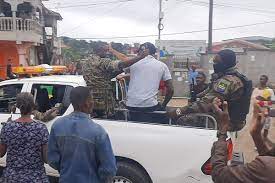
Latest Updates on Gabon Coup in the Capital, Libreville.
In a recent development, Gabon has been thrust into turmoil as a group of uniformed Gabonese soldiers made a stunning announcement on national television. They declared the dissolution of all state institutions and the nullification of the country’s contentious elections. This dramatic move came on the heels of the declaration of longtime leader Ali Bongo as the winner of the presidential race held just last week.
Read also : Revised Sassa Payment Schedule for September
Read also : Read also :Senior Ukrainian intelligence officer commits suicide
Read also : Wagner Group Leader Prigozhin Confirmed Deceased in Moscow Plane Crash
The soldiers, making their announcement during an early Wednesday morning live address, proclaimed their mission to ‘defend peace by bringing an end to the current regime.’ They asserted their authority on behalf of the enigmatic ‘Committee for the Transition and Restoration of Institutions,’ according to reports from AFP news agency.
A spokesperson for the group strongly criticized President Ali Bongo, attributing the current state of affairs to his ‘irresponsible and unpredictable governance.’ They argued that Bongo’s 14-year tenure had led to a ‘deterioration in social cohesion’ that risked plunging the nation into chaos.
In the aftermath of this declaration, AFP journalists on the ground reported hearing gunfire in Gabon’s capital, Libreville, though it remains unclear if any significant clashes have occurred. The tension was palpable.
The Gabonese Elections Centre had previously declared Bongo the victor of the recent presidential election, with just over 64% of the vote. He secured a decisive victory, leaving his primary rival, Albert Ondo Ossa, trailing far behind in a single-round ballot.
It’s worth noting that this is not the first time Gabon has witnessed such a dramatic upheaval. In 2009, Ali Bongo ascended to power, and in 2019, the nation faced another military coup attempt. During that turbulent episode, armed military officers took hostages and announced the formation of a ‘National Restoration Council’ with the aim of ‘restoring democracy in Gabon.’ However, the mutiny was swiftly quelled, resulting in relatively few casualties.
Gabon, a Central African nation with a population of approximately 2.3 million, shares its borders with Cameroon, the Republic of the Congo, and Equatorial Guinea. It was a former colony of France before gaining independence in 1960.
This development in Gabon echoes a broader trend in former French colonies in Africa. Just recently, Niger experienced a military coup in late July, plunging the West African nation into a state of uncertainty. The situation in Niger remains highly tense, with the regional ECOWAS bloc contemplating a Paris-backed intervention to restore Mohamed Bazoum, the deposed president. Mali and Burkina Faso, both of which have experienced military takeovers in recent years, have pledged to defend Niger’s new government from external pressures and potential interventions.
